
The Tongue Machine
opening

[opening to The Tongue Machine, due to be published by Schism Press on 12 March]
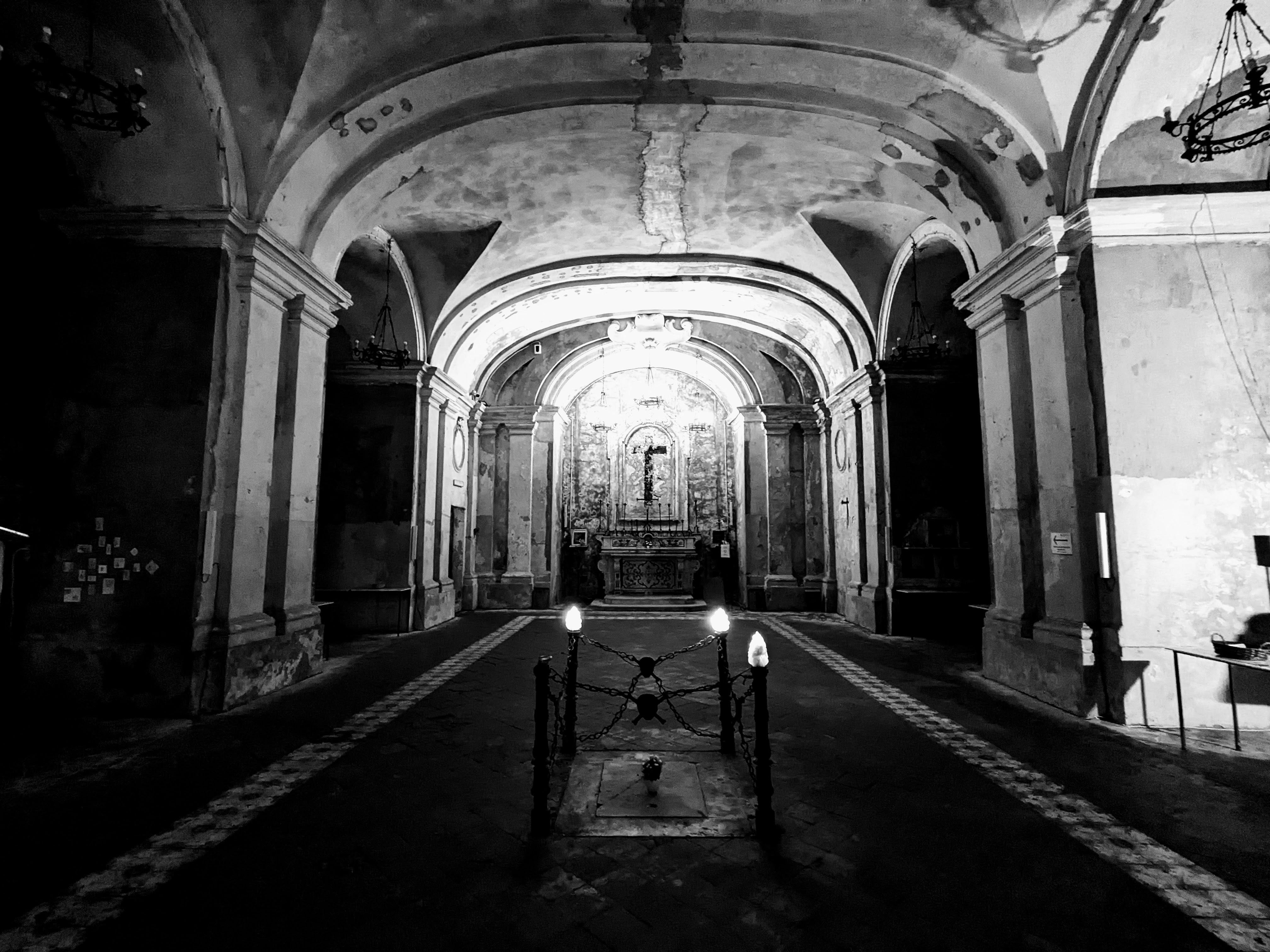
It was a mere after effect of spending too long with the dead in the Santa Maria delle Anime del Purgatorio ad Arco, a name longer than he would remember and it hardly mattered for his decision was decided without the need to think—never to go down again—even though being returned among the living had never been so intense. He found himself alone in the lower side crypt, a rough chamber with its paved walk between mounds of earth and mortarless brick walls. The room was entered by a long and narrow passage of bone-filled recesses that he walked in abject silence from the main crypt, itself dismal, although the bones were in boxes there. The scarabattoli or glass display cases had been painted over in this larger vaulted basement by a putrid cream and flaky concoction to preserve the simulated privacy of their contents—each yet another anonymous collection of fibula and ribs—he glimpsed in, the paint was scratched away before him by previous visitors to small peep holes in the glass encasements. Each casement seemed improvised and shoddy and hardly well attached on rotten brackets in this church of purgatory basement as he knew it and which he had visited only on a whim during this second stay in Naples, so not even unadvisedly. It would be an exaggeration to claim time among the dead in a graveyard, whereas in the lower side crypt it felt understated to think he could taste the mould in the earth around him as he looked at the anonymous skulls in their open recesses and from which he might have drawn a tooth, should he have liked, though he could not bear to be among them, had been affected by this open tomb of human remains and recesses of the lost and forgotten in a manner he would never himself have thought possible. The ossuary he visited below St. Leonard’s Church, Hythe, Kent, had meant nothing alongside, though its skulls were far more numerous, more than a thousand there collected and shelved, the remains overall with the other bits included totalling two thousand dead. Bones alone never disturbed him. It was a matter of their placement, here, there, in the Naples crypt, and the damp quality of the air around, the dust covering the pieces and the rank pillows on which some were rested, the veil that part-covered another, the little votive offerings draped and interpolated, mostly the junk he had seen on sale for tourists, little glass talismans, chili peppers threaded on a string and so on, but also photographs of other more recently departed—perhaps lost at war, or just lost—but still old themselves by the look of them, having the clothes and hairstyles and expressions of the last century, his twentieth and theirs, these realisations of their time, the hair the clothes the faces as they looked at the cameras of their moment, all features clearly visible despite their fading and the poor light. It was rank to use words to describe it. It was rank to hear the words then used. And if these words were written into a novel, would they be anything more than the exploitation of his experience. Those who wrote from experience had always cheapened that experience and then cheapened it further by telling themselves the opposite. All words were obscene in this context, as rank as the reflex to withdraw a camera from his pocket, which he resisted. Here, strewn about the bones, were the paper records of dead Catholics from a century whose decades had grown old themselves—a dismal thought on its own. Turning round and then away from the earthen mounds and under which other dead bodies presumably lay but cosied in the dirt, he looked into a shaft which led to a further crypt reaching into a lower stratum of the Neapolitan filth, and there down below were more bones and offerings and thrown-in tat, and the memory of his descent into the cellar of a nineteenth-century terrace in a northern English town, the one he had lived at, in which there was then strangely another stair return to another cellar directly below, and he followed down to another stair return and on until he had descended many floors into the dank earth beneath his own home, there was no end to it, only a decision to not go further and from which he could only emerge profoundly adjusted. It was in this condition of weakness that he found himself sitting in the world above, physically warmed but only that, chancing to be sat, in fact, within the vicinity of a man, another misguided compatriot who, finding himself before a fellow in a subservient state—a temporary diminishment, his weakening—decided himself to whisper in his fellow’s ear a confession from which words, he said, an entire world shall be built.