
Gordonalia
an excerpt from the unpublished novel Situations

[forthcoming in CounterText]
The following extract[1] from Situations returns to the figure of Gordon who first appeared in The Sick List, a novel published by Boiler House Press in 2021. It adds further detail to the Gordonalia—the collected rumour-compendium of a life that was never envisaged as liveable. Gordon is not so much a character as a device, or principle (if such a word can be used) of a certain kind of criticism in which the position of the critic remains obscure, both in terms of their chief arguments, these will be multiple and will lack overall consistency, but so too in terms of the moral positions of the critic, they will also remain uncertain and shall invite suspicion. It notices but provides no remedy to the situation of university criticism, which operates in the context of advanced institutional decay and the familiar torpors that accompany performativity—the contemporary university is an idiot machine of sorts, a sophisticated system for embedding the vapid state at the core of what some misleadingly call ‘academic culture’, which raises the question of how the University could have been so vulnerable to the external aggressor which goes by many names, inter alia, managerialism, anti-intellectualism, neoliberalism, and so on, and whether or not there was something resolutely pedestrian and so anti-intellectual already embedded in its so-called intellectual heart—these are the conditions from which Gordon emerged. Divergent writing offers little, even if this little (in such contexts) can still be a large amount, the possibility of some kind of break with established forms, a glimpse at alternative thinking practices, and perhaps too the added effect of maintaining a disposition, or an outlook, slightly out of kilter with everyday performance. This is the performance a university employee will have to perform in order to remain, not so much employed (the idiot machine will happily sack the polite and industrious), but not entirely disliked by those they work amongst.
[1] This extract from the unpublished novel Situations was first presented at the CounterText roundtable on Frame/Framing in Wroclaw, 2025.
Between Gordon’s years of speaking and his eventual muteness, he spent several months, perhaps years, uttering words without sentences. Little is known of this period, although it is claimed the university lost its way at a similar time.
The indeterminate nature of even the simplest word struck Gordon as exemplary, so it has been said, given how each word can point in multiple directions and borrow multiple associations. It has been suggested that if a sentence is open for two divergent readings because of the indecision of one or two of its words, both readings will be true. But even here the words in question, including those with two allowed senses, will be subject to severe limitation. This could be why Gordon came to dislike most sentences, or the presence of a context, or contextualising detail, textual or literal, which can obliterate the potentiality of the words it houses, and why he felt that words must be returned to and we must attempt to deploy them in all senses at once, a suggestion which cannot be enacted and can never be made with due seriousness, and so it was that Gordon made it.
There is the claim that among the solutions Gordon presented for realigning, or reconstituting, the basic parameters of the organisation in which he worked, was simply this: to speak a different language, not a foreign language but a different one, and do so in the presence of the university, and cleave to that different language in that university setting as if it were nothing at all. This solution was another of his non-solutions as indeed it had to be, given the draw of language to its parameters and the call of language to submit to the situations of dialogue and civility. This draw back to the normative call of language would always prevent anyone who attempted to enact Gordon’s recommendation, his call to speak a different language, from achieving their object.
By another account, Gordon once attended the class of an English Professor. The man was attempting to enliven his students to the richness of words and say something indeterminate—but highly apposite, he would have thought—about the nature of language. This English Professor was mediocre in all respects and would never have been appointed a decade on. But this judgement applied to most. Few if any would have reached professorial status under the subsequent regime, when what it meant to be a professor, even of the middling sort, was obliterated from memory. In this latter-day regime it was impossible to know what the act of professing had once entailed. Nobody could know anymore how to acquire the means and nobody knew what their acquisition felt like, which meant that it was impossible to grasp what intellectual failure looked like too. Intellectual failure had ceased to signify. These subsequent professors could only fail in other respects as the professorial class was eventually and finally subsumed into the institutional machinery, a fascist engine.
The English Professor had done well, under the circumstances. He was still surrounded by exemplars of professorial bearing he might borrow from freely, and in these older and softer regimes such efforts to meet the stature of his peers by simulating their bearing need not be maintained indefinitely. He had come to write almost nothing and, in his teachings, most of his key intuitions were half remembered bits of theory he had never entirely understood but considered significant at the time he first encountered them. The man would recycle his bits and pieces each year, and with every year that passed the memory of the writings that prompted him to think, grew dimmer.
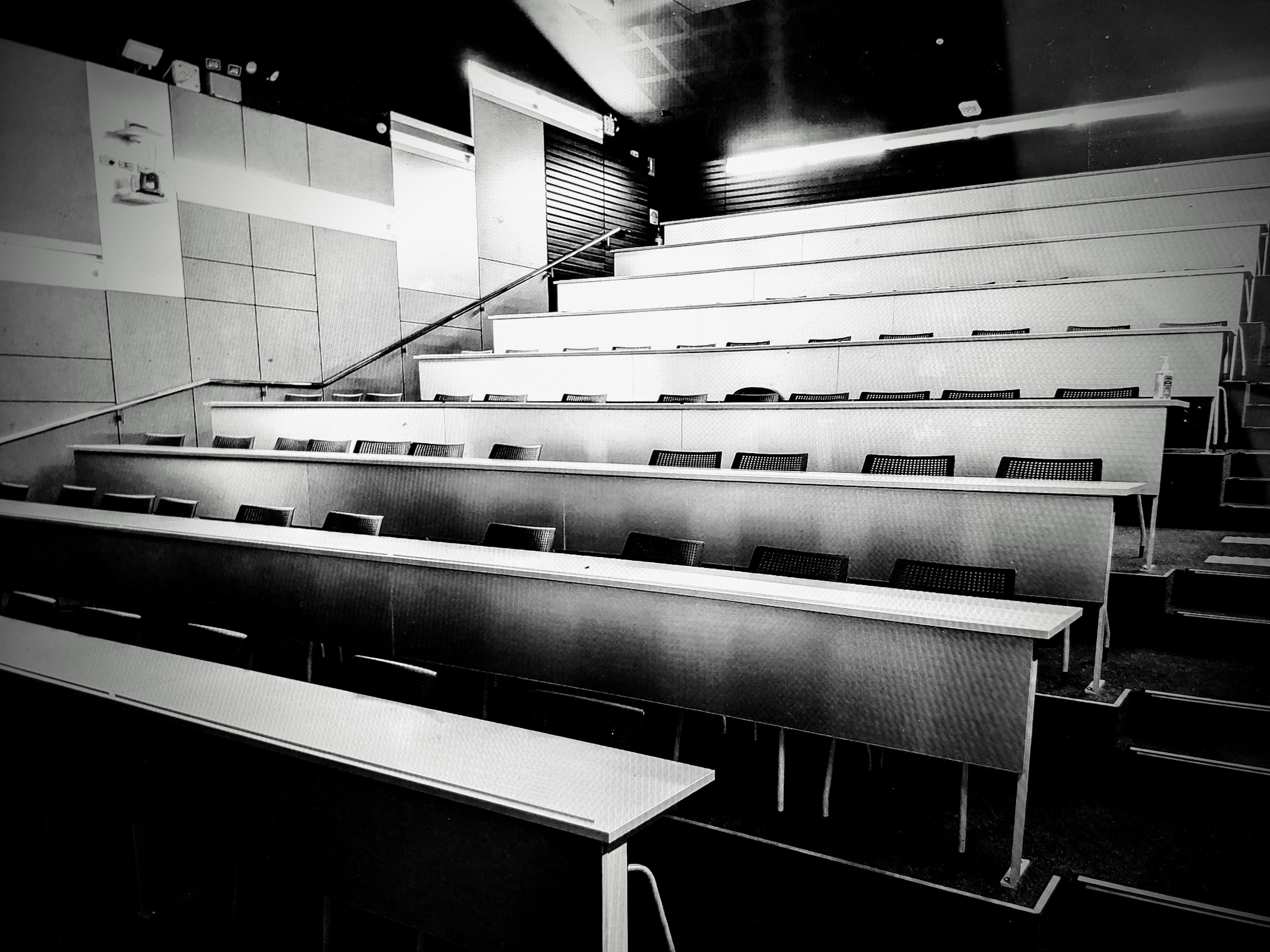
Gordon arrived when the class was not yet half done and sat back at the back, the Professor said. He came in, set himself down in the very last row, and looked at me across the benches. We exchanged glances and then I merely continued with the lecture. There was no reason he should have been there, but at the time the Professor felt there was not much he could do about it, least of all draw his students’ attention to the silent figure now sitting at the very rear of this large yet barely populated lecture theatre. The theatre was so big, and the number of students taking his class was so small, that the usual lurkers who sit in the last row would not sit there—it would be unseemly even to them—and so the lurkers sat in the far left or in the far right aisle of benches, leaving the centre section for the usual suspects, those who asked questions and intruded upon his time at the beginning when he was setting up, during the break, and after the lecture when the Professor did his best to escape them.
Given Gordon’s growing notoriety, he said, I have come to reflect again on that day when Gordon came and sat at the back of my lecture. On reflection, he reflected, Gordon arrived at the most auspicious moment. I was riffing (the Professor did not say riffing but might have done). He was certainly improvising. The topic of my talk was the concept of the frame. I was expatiating (another word he did not quite use) on the concept of the frame to demonstrate not only the richness of language but its indeterminacy too, and so the availability, within language itself, to escape fixed ways of being, and how this possibility is inherent to most words, and so, word substitution was less necessary in the creative act, than word redeployment. Even a limited vocabulary has within itself the resources to rewrite history.
The suspicion has arisen among some that these were actually Gordon’s words, and Gordon’s ideas, but none have put it to the Professor himself.
The Professor now thinks he should write up that segment of the lecture which he devoted to the word, frame, and its near associates, and use that lecture to frame Gordon’s character. When Gordon arrived at my lecture, the Professor said, he arrived at the most pertinent point since I had just begun discoursing on a word that was highly relevant to his own self. It was hard to shake my own self from the feeling, the Professor continued, that when I stood there improvising for the benefit of my students, I was actually writing Gordon’s obituary. Gordon arrived just as I was, in effect, writing him up.
